
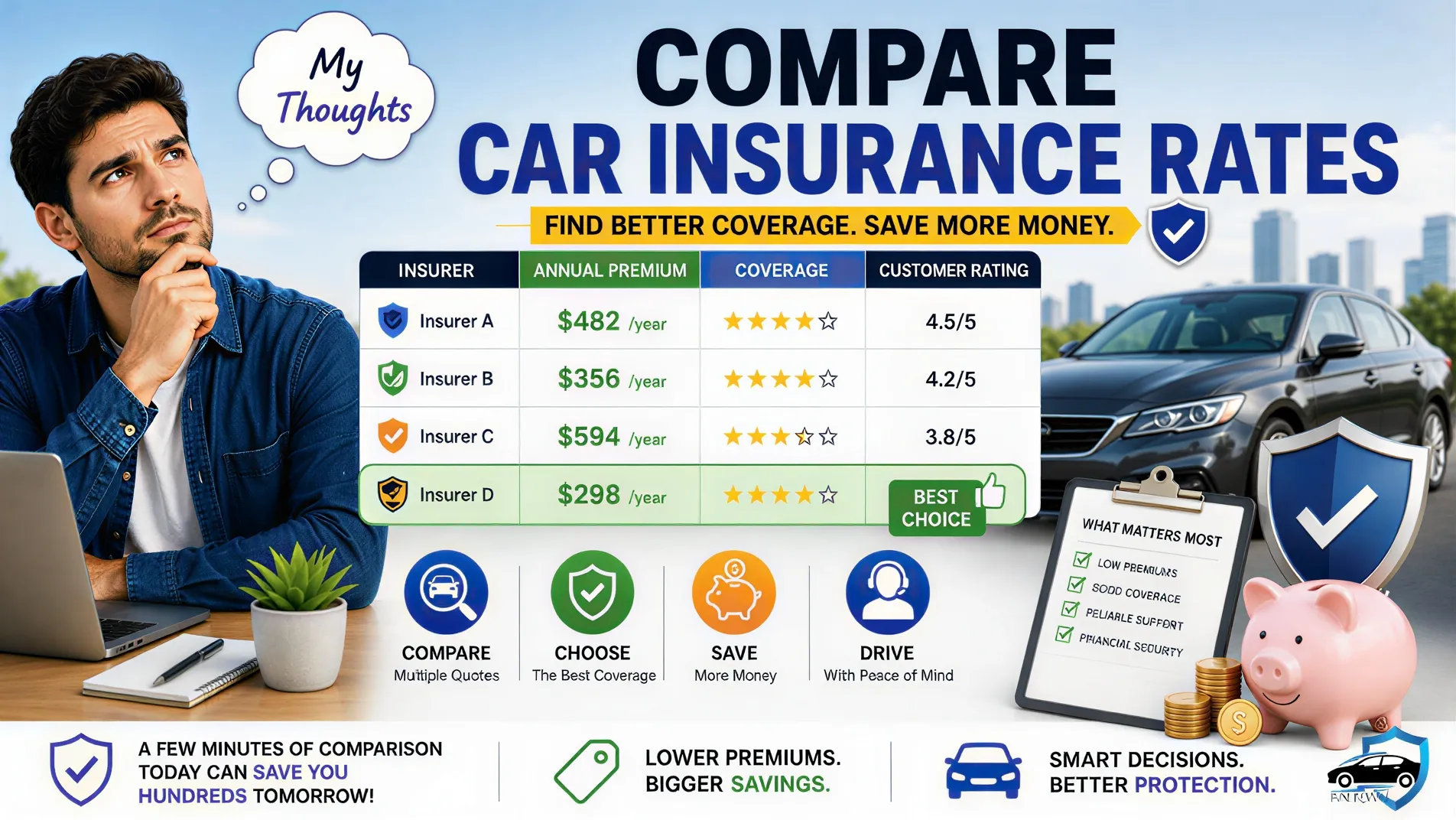
Learn how to compare car insurance rates in 2026, evaluate coverage, deductibles, discounts, insurers, and personalized quotes, and find affordable protection without sacrificing essential coverage.
Introduction
Car insurance may be one of those costs that sneaks up on you and consumes a big portion of your monthly budget. You can keep the same policy from one year to the next, pay your premiums on schedule and think that you are doing a good deal. The cost of insurance is always changing, and the firm that provided you with a competitive rate last year may not be the most affordable this year.
That is why getting to know how to compare car insurance rates can be one of the easiest methods of lessening the insurance costs. Insurers treat drivers differently, price drivers differently and provide different discounts. Two companies can compare the same driver and vehicle, and have premiums that differ by a factor of 10.
The objective should not be just to get the lowest number, though. A low cost policy that doesn’t provide enough coverage can leave one vulnerable should an accident occur. Rather, smart insurance shopping involves comparing insurance coverage, knowing what deductibles and limits are involved, researching the reputation of the insurance company and finding out whether or not there are any discounts that apply to you.
Keep reading to learn more about what you need to look into before you begin shopping for auto insurance in 2026, such as getting information, requesting quotes, and comparing coverage and insurance companies.
There are many reasons why you should compare car insurance rates

It is not the case that everyone who drives is insured at the same cost by any insurance company. Every insurance company will have different underwriting criteria, claims history, risk processes, discounts and pricing.
For instance, one company may provide a nice reward for a driver with a clean record but will be much more expensive after an at-fault accident. If there’s another insurance company that offers a better deal to people with a speeding ticket or a different credit history, this is possible as long as the law allows.
The location can also have a significant impact. Because of differences in traffic, weather, number of accidents, theft, repair costs, medical costs, or insurance regulations for each state and city, as well as the ZIP code, insurance rates may differ.
Shopping around gives you a better idea of the cost of your personal risk profile.
One other reason to compare car insurance rates is because your situation will change throughout time. Premiums can vary based on a number of different factors, including your age, vehicle, mileage, driving record, credit-based insurance score (if available), household drivers, and your coverage needs.
With any insurance company, there’s no certain way to know that it’s still the most economical choice after a year or two.
So, what factors influence your car insurance rates?
It’s useful to know the reasons for premium differences before requesting quotes. Insurers take into account the driver, the vehicle, the location, the coverage and risk-related data.
Driving History
Your driving record is one of the top things that an insurance company may look at.
If you don’t have a recent accident record or moving violations, you may qualify for better rates with some companies. Conversely, fines for speeding, at-fault collisions, reckless driving and DUI can have a significant impact on premiums.
It also depends on the insurer when it comes to the effects of an incident. Some companies might charge you a lot more after you get in an accident, and some might charge you less.
This is why it is important for a motorist to have a less than perfect driving record to know that it won’t cost about the same at every insurance company.
Age and Experience
The number of years one has been driving and their experience.
One reason that age might impact insurance rates is because the insurance company will look at past claims to determine risk.
If you are driving with little experience, you may end up paying more. Rates can get cheaper as drivers develop experience and have a positive driving history. Rates are also subject to change as older drivers fall into various age categories.
Age is another factor to consider when shopping for car insurance quotes over and above the differences in pricing from one insurance company to the next.
Vehicle Make and Model
Your vehicle can have a huge impact on your premium.
Insurers may consider:
- Vehicle value
- Repair costs
- Theft rates
- Safety features
- Crash-test performance
- Engine size
- Replacement-part costs
- Historical claims
- Vehicle type
Your insurance premiums may be higher for a sports car, luxury car or one that is expensive to repair versus a car that is cheaper to repair.
But purchasing a cheaper car doesn’t necessarily mean that the insurance will be cheap. The easiest way to know actual price is to get quotes on actual vehicle you will insure.
Location and ZIP Code
Your premium may be affected by your ZIP code since insurance companies assess the risks in the area.
Frequent accidents, theft and vandalism, severe weather, traffic and high medical costs/repair expenses can lead to higher insurance premiums.
This means that a person just a couple of miles from you may be offered a different quote.
Credit-Based Insurance Information
Insurers can include credit-based insurance information as one factor in determining premiums in the states where credit-based insurance information is legally allowed.
Some insurance companies may offer better rates to drivers with good credit, and worse rates to drivers with bad credit.
This is one of those factors that varies by state, so it is critical to know how this is addressed in your area.
Coverage and Deductibles
The more coverage you opt for, the higher your premium will be.
The higher the liability limit, the more financial protection it offers, but may incur a higher cost. Comprehensive and collision coverage also make the policy more expensive than just a liability only policy.
The deductible is important too. The higher the deductible, the lower the premium, but you’ll likely have to cover more of the expenses yourself before you get paid for some covered claims.
The balance will vary depending on your financial situation and level of risk tolerance.
How to Compare Car Insurance Rates Correctly
It’s helpful to obtain a few quotes, but picking the cheapest one is a bad call.
The quotations must be in the same format.
Sometimes a lower quote will be from one insurance company and the higher quote will be from another insurance company.
1. Gather Your Information
Begin with information insurers will most likely need.
You will need:
- Full name
- Date of birth
- Address
- Driver’s license information
- Driving history
- Accident history
- Traffic violations
- Current insurance information
- Occupation
- Marital status
Collect for every vehicle:
- Year
- Make
- Model
- VIN
- Current mileage
- Annual mileage
- Information on ownership or financing
- Vehicle safety features
More meaningful quotes result from having accurate information.
2. Please note that the coverage limits remain the same
When it comes to comparing insurance, one of the most important things to do is to use the same coverage.
Assume that Company A charges $1200 per year and Company B charges $1450 per year. Company A appears to be the lesser expensive option at first glance.
Now, suppose that Company A has lower liability limits and a $2,000 deductible, and Company B has higher liability limits and a $500 deductible.
Those prices aren’t necessarily comparable.
As far as possible, maintain consistency of the following:
- Bodily injury liability limits
- Property damage liability limits
- Uninsured motorist coverage
- Underinsured motorist coverage
- Comprehensive coverage
- Collision coverage
- Deductibles
- Optional coverage
It’s not going to be a meaningful price comparison unless you have the same coverage.
3. Request Several Quotes
Don’t have to seek out a lot of quotes to obtain valuable information.
One effective approach is to get quotes from a few insurers, such as large national carriers, regional insurers, and insurers that have a specific interest in certain types of drivers.
One way this can be made easier is by using comparison websites, which require you to enter your data just once and then check out multiple options.
Keep in mind, though, that comparison sites are not going to list all the insurance providers in your state. There are also insurance companies that sell insurance policies directly, and others that have independent agents.
4. Consider the Premium
Price is important but not the most important.
When shopping around for car insurance, consider the entire package.
Consider:
- Coverage limits
- Deductibles
- Discounts
- Claims handling
- Customer service
- Financial strength
- Complaint history
- Policy features
- Roadside assistance
- Accident forgiveness
- Mobile app functionality
- Payment options
A higher cost insurance company may offer more coverage or service, and may end up being a better value.
The Difference Between Rate and Premium

Rate and premium are often interchangeable terms, but not synonymous.
Insurance rate forms part of the pricing structure of an insurance company which calculates the cost of an insurance policy for various risk factors.
Premium is the total amount that you pay to your insurance policy.
Your final premium will vary depending on your driving record, vehicle, coverage options, location, discounts and any applicable surcharges.
It is important to note that sample rates are not necessarily personalized quotes, as they are published.
An online rate may be for a driver with a specific age, car, location, coverage, driving history, and credit score. Your actual premium could be considerably different.
Full Coverage vs. Minimum Coverage
When choosing insurance coverage, one of the most important decisions you’ll make is choosing how much protection you require.
Minimum Coverage
Each state has its own minimum insurance requirements.
In general, the minimum coverage is liability coverage which will cover some of the injuries or property damage you inflict on someone else in an accident.
May not protect vehicles owned by you.
Low coverage may be tempting if you are primarily interested in keeping your premium as low as possible, but it may be a costly choice if you get involved in a severe accident.
Full Coverage
Full coverage is not one specific insurance product. A common use of the term is to refer to a policy that includes comprehensive and collision coverage as well as liability insurance.
After the car is destroyed in a collision covered by your policy, collision coverage could help cover the cost of its damage (up to your deductible).
Insurance can cover a range of non-collision costs, including theft, vandalism, weather damage and other covered costs.
Financed or leased car owners might need to have some coverage, as mandated by their lender.
Establishing Appropriate Limits
Not always the cheapest is the smartest policy.
When you are involved in a severe accident, if your liability limits are too small, you may be liable for more than your coverage.
When choosing coverage, consider assets, income, car value, debt and your risk tolerance.
Discounts can help to reduce your premium
Price reductions can have a significant impact on your cost.
Discounts are offered by different companies and in different states and may include:
Safe Driver Discounts
Drivers who have clean records may be able to get cheaper rates.
There are also some insurance companies that have telematics programs that use driving habits to qualify for insurance discounts.
Multi-Policy Discounts
Sometimes, an auto insurance policy can be bundled with a homeowner’s or renter’s insurance policy to earn a bundling discount.
Don’t assume that bundling is always less expensive, however. Compare the total cost with buying policies individually.
Multi-Vehicle Discounts
If you have more than one vehicle, a discount may be available if you take out a policy with the same company.
Good Student Discounts
Some insurance companies will give a discount to those students who achieve certain grades.
Safety and Anti-Theft Discounts
Some cars can benefit from discounts with some insurers if they’re fitted with safety features or anti-theft devices.
Low-Mileage Discounts
Some companies may offer lower premiums for drivers who drive fewer miles.
Find out from each insurance company if you have discounts; don’t assume they are all the same.
How Your Driving Record Changes Quotes
Your driving record can greatly affect the rates you pay for insurance.
Two different customers who have no violations on their driving records will get very different quotes from a driver with:
- A speeding ticket
- Multiple traffic violations
- An at-fault accident
- A DUI conviction
- A reckless-driving violation
But if your driving record is expensive it doesn’t imply that you must just take the initial quote you are offered.
Insurers assess risk in varied ways and there could be big differences when shopping around.
The same applies following an accident. It can be a case of one insurance company getting a lot more expensive as another stays pretty competitive.
Car Insurance for Drivers With Poor Credit
If permitted by state regulation, credit could also be a vital pricing consideration.
Shopping around is particularly important if your credit profile is impacting your premium, as insurers may be assessing credit related risk differently.
Just because a company may be the cheapest to one person with excellent credit doesn’t always mean that it will be the cheapest for you.
Rather, give true details and ask for customized quotes from several insurance companies.
Be aware, too, that enhancing your finances could come in handy over time, depending on the laws in your state and the practices of the insurance company.
When To Compare Insurance Rates?
You don’t have to change insurance companies annually.
It’s a good idea to review your policy periodically though.
When you think of getting new quotes, think of:
- Your policy is due to renew.
- Your premium has gone up.
- You have changed your address (ZIP code).
- You bought another car.
- You’ve settled the debt on your car.
- Your driving record is better.
- The accident or violation does not remain on your record.
- Your household changed.
- You began to drive less.
- There’s an update on your coverage requirements.
- New discounts are available.
Even if you stay with the same insurance company, knowing your options can help you know if your existing policy is competitive.
There are common mistakes to avoid when comparing insurance plans

Few drivers consider more than price, and miss out on important factors.
The cost of different coverage levels
This is probably the worst mistake, the problem.
A lower quote could just mean that the coverage is lower.
Be sure to look for the same limits and deductibles.
Selecting the lowest premium automatically means that you are selecting the most affordable premium
A low-priced policy might provide less coverage, fewer optional features, or a higher deductible.
Think quality, not price.
Providing Inaccurate Information
Don’t give false details to get a cheaper quote.
When the information used is incorrect, the premium can also be incorrect, and will likely cause issues if a claim is filed.
Ignoring Discounts
Request all insurers to go over any discounts they may offer.
Savings may not be automatically included in the initial quote.
The app includes only national companies
Big insurance companies don’t necessarily offer the lowest prices.
Local airlines may have better fares in certain states or locations.
Ignoring Customer Reviews
Claims are when insurance is needed most.
Consider customer satisfaction, complaint data, claims history and independent ratings before making a final selection.
Not verifying the final policy
An online quote is not necessarily the final policy.
Review the declarations page and policy documents before buying to ensure you are covered, to the extent, the deductible, the premium and the applicable coverages and endorsements.
The following tips will help you save money on your car insurance
Knowing the comparison process better, you can make further efforts to save money.
Consider carefully increasing your deductible
If after an accident, you can afford to take a higher deductible without the added cost, you may be able to save on your premium.
However, don’t choose a deductible amount that would cause a hardship.
Review Your Mileage
If you’re driving less than you did at the time of your purchase, let your insurance company know.
Some carriers may increase your premium if you spend fewer miles per year.
Ask the questions: What questions should I ask for Usage-Based Insurance?
A few insurance companies have driving habits assessment programs in place that use a device or app.
This may offer a savings opportunity if you feel like you can participate and drive safely.
Remove Unnecessary Coverage
Some optional coverage purchase options may need to be reviewed as your car gets older.
For instance, if a car’s market value is small, you might consider looking at the value of comprehensive and collision coverage.
Don’t go with the top price. Think about how much the car is worth and what you can do to replace it.
Winding when appropriate
Combining home, renter and auto insurance can make life easier in terms of managing policies and may also offer discounts.
Nevertheless, take into account overall cost, not just the cost of any single policy.
Maintain a Clean Driving Record
The following tips will help keep you safe on the road and avoid costly violations and accident tickets.
It can even assist you obtain favorable rates and discounts from a few insurance providers.
Is it a good idea to use an insurance comparison website?
Comparison websites may save you a bit of time since you might be able to see several insurers without having to submit your data to each website individually.
They may be beneficial when you are:
- Purchasing insurance for the first time
- Moving to a new state
- Having a premium increase
- Incorporating a new vehicle
- Trying to find more affordable insurance
- Comparing coverage options
However, there are some drawbacks to comparison sites.
Not all insurers are in all platforms. Some companies sell directly to customers, some companies have agents.
When shopping for insurance, you can combine comparison tools, direct insurer quotes, and independent-agent assistance (when applicable) for the most complete shopping process.
What information do you need for a quote?
The more information you have ready, the quicker you can prepare.
Your driver’s license, vehicle registration, VIN, current policy information, mileage and other household drivers information may be required.
It’s also important to be familiar with the coverage limits and deductible you want.
It can be helpful to have your current declarations page on hand, since it will give you an overview of your current policy.
You can use it as a reference for a quote that you’re seeking from a competitor.
When it comes to choosing the right insurance company, it isn’t just about the price
There are multiple aspects that need to be considered when choosing an insurer.
Financial Strength
A good insurance company should have sufficient financial strength to honor its commitments and settle legitimate claims.
Financial-strength information may be provided by independent rating organizations.
Customer Service
It isn’t very comforting to have a low premium if you then have a bad experience when you need it.
Check for ratings and reviews on customer satisfaction.
Claims Experience
Handling claims is among the essential facets of an insurance company.
Find out what customers say about the claims process and if they seem to have a higher than average number of complaints compared to other insurers.
Digital Experience
If you’re looking for a policy that can be managed online, check out the insurer’s website and mobile app.
Digital ID card, online payments, claims reporting, and changes to policies can make insurance more manageable.
Available Coverage
Coverage options vary from one insurance to the next.
Check if you can get roadside assistance, rental reimbursement, accident forgiveness, gap coverage or any of the other optional coverage features, before you buy them.
Once you have located a better quote, here are some things you want to do

Just because you can find a lower quote doesn’t mean you should cancel your policy right away.
Before making such a change, check to ensure the new policy offers similar coverage.
Check:
- Liability limits
- Comprehensive coverage
- Collision coverage
- Deductibles
- Optional coverage
- Effective date
- Discounts
- Total premium
Verify that the new policy is in effect, and then cancel the old policy.
Avoid creating a gap between policies.
When changing over at renewal, make sure dates are taken into account. When changing policies, make sure to find out if your current provider has any cancellation policies or fees.
Is the cheap car insurance the best?
Not necessarily.
The purpose of insurance is to help you avoid financial injuries and some cheap insurance policies may cause complications in the future.
Imagine two policies:
| Feature | Policy A | Policy B |
|---|---|---|
| Monthly Premium | $100 | $120 |
| Liability Limits | Low | Much higher |
| Deductible | $2,000 | $500 |
Policy B might offer a much greater degree of protection, but at a higher cost.
The best option is based on your requirements, budget, car and appetite for risk.
That’s why a smart shopper doesn’t just consider the monthly payment.
Final Thoughts
Shopping for car insurance can’t be as daunting as it sounds. The secret is to look at it as a comparison, rather than just find the cheapest monthly payment.
Get accurate information on yourself, your household drivers and your vehicle. Determine coverage needs, set a fair level of coverage and deductibles, and get several custom quotes.
Next compare each insurance company with regards to price, coverage, discounts, customer service, claims experience, financial strength and convenience.
What is the cheapest for other driver might not be the cheapest for you. Prices for insurance vary greatly, especially since there is a great deal of individualism involved in pricing.
Most important of all, regularly check your policy. Of course, your situation can change, as can the price of insurance, and if several years ago a policy was a good deal, it may not be a good deal now.
Just a bit of shopping around for car insurance rates can help you make an informed choice, lower the premium and ensure that you are still getting the coverage you need.
Smart insurance shopping isn’t a matter of getting the lowest price for the lowest coverage. It’s a matter of right price, protection, flexibility, and service, but it’s also about finding the right balance.
Those four factors, when included in your decision, will help you select coverage that is beneficial for your finances as well as your vehicle.
FAQs Related to Compare car insurance rates
1 . Why is it important to look around for car insurance quotes before purchasing a policy?
When you compare car insurance rates, you are able to choose the best coverage at a lower price. Each insurance company will determine their rates in a different way, and the same driver may have different rates from one insurance company to another.
2 . What factors should I consider when evaluating different quotes?
It’s a good idea to compare car insurance rates at least once a year or whenever you experience major life changes, such as buying a new car, moving, or adding a driver to your policy.
3 . Does Shopping for Car Insurance Will have a Negativ effect on My Credit Score?
No. The majority of insurance quote comparison services conduct a soft pull of your credit information that won’t affect your credit score.
4 . What information do I need to compare car insurance rates?
A driver’s license, vehicle information, driving history, coverage information, and estimated annual mileage will generally be required.
5 . What are the pros and cons of using online car insurance quotes?
Yes. Rate shopping provides the ability to rapidly review several insurance quotes and discover discounts that are available when shopping for car insurance, making it easier to find a good value and possibly save hundreds of dollars per year.